

Buying guide · grand piano
Your first grand piano: Thomann GP 160, Yamaha GB1 or Kawai GL-10?
A grand piano fills the room with sound and answers the smallest movement of your fingers. But it is also a big decision – in price, space and weight. Here are three small grands that all fit a living room.
Ad · this guide contains affiliate links. If you buy through a link, ZOZIZA may earn a commission. Your price is the same.
Grand or upright?
On an upright, the strings stand vertically and the hammer is pushed back by a spring. On a grand, the strings lie horizontally and the hammer falls back by its own weight – so the action can strike again before the key is fully up. That gives freedom in fast repeated notes and trills. And the sound rises from the soundboard and out under the lid into the whole room, not into a wall.
What does the length mean?
The longer the grand, the longer the bass strings and the larger the soundboard. All three here are 151–160 cm – small or baby grands – so what you hear is more the brand's character than the length. For a noticeably bigger bass, you need around 180 cm.
| Thomann GP 160 | Yamaha GB1 K | Kawai GL-10 | |
|---|---|---|---|
| Length | 160 cm | 151 cm | 153 cm |
| Weight | 315 kg | 261 kg | 282 kg |
| Action | Renner (Germany) | Yamaha | Millennium III (carbon-reinforced) |
| Tone | Newer brand – try it | Clear and bright | Warm and round |
What you feel in your fingers
A grand is not heavier to play – but it is more honest. It shows the difference between a soft and a hard tone more clearly, and tension in your arm is heard straight away. Spend the first weeks playing slowly and softly, letting the weight of your arm sink into the key. The left pedal shifts the action so the hammer strikes fewer strings – a different colour, not just quieter.
Three grands for the living room
A real grand for the least money: Thomann's own brand with Renner action and hammers, regulated and tuned by the retailer's piano technician. A newer brand – try it if you can.
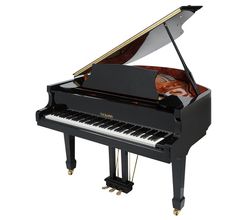
Thomann GP 160 E/P
- Length 160 cm, 315 kg
- Renner action and hammers, soft-close fallboard
- Bench and 5-year Thomann warranty
51.700 kr checked 15.10.2026
See price at ThomannA well-known brand in living-room size: Yamaha's smallest grand, clear and bright, with a sostenuto middle pedal.
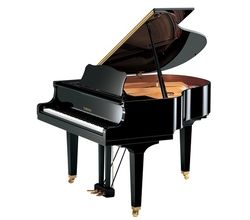
Yamaha GB1 K
- Length 151 cm, 261 kg
- 88 keys, 3 pedals
- Polished black
85.400 kr checked 15.10.2026
See price at ThomannThe warmest tone: Kawai's Millennium III action, soft-close key cover and bench included.
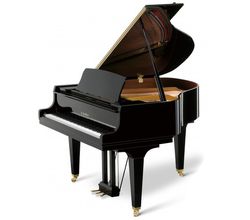
Kawai GL-10
- Length 153 cm, 282 kg
- Millennium III action, sostenuto pedal
- Soft-close key cover, bench included
90.300 kr checked 15.10.2026
See price at ThomannWant to practise silently too? The Yamaha GB1 is also available with SC3 Silent.
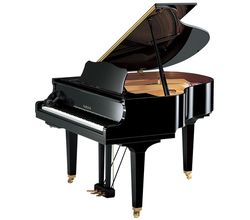
Yamaha GB1 K SC3 flygel
- 151 cm grand
- Yamaha SC3 Silent: hammer stop + headphones
- 12 voices, Bluetooth MIDI/audio
116.500 kr checked 30.9.2026
See price at ThomannSee every grand on the acoustic piano page or in the catalogue. Thomann ships worldwide – you see the price in your own currency.
Before you buy: four things
- Space. Count on about 2.5 metres from the wall, with room for the bench and the open lid.
- The room. Bare walls and a wooden floor make a grand very loud. A rug, curtains and a bookshelf soften it – or play with the lid half open.
- Weight. 260–315 kg. Talk to the retailer about delivery, stairs and doors.
- Tuning. Once or twice a year, a little more often at first. Keep it away from windows and radiators.
Try this tomorrow
Play the same chord five times, from as softly as you possibly can to full. Listen for how many steps you can hear. Do the same in the shop, on every grand you try – on a good grand there are more.
Questions
How much space does a grand piano need?
A small grand is 151–160 cm long and about 150 cm wide. With the bench and room for you, count on about 2.5 metres from the wall.
Is a Yamaha or Kawai grand better?
Both are good. Yamaha usually sounds clear and bright, Kawai warmer and rounder. Try both and choose the sound you want to stay in.
How often does a grand piano need tuning?
Usually once or twice a year, and a little more often in the first years after delivery.
More guides: Acoustic and grand pianos · Silent piano: Kawai or Yamaha? · Piano lamps