

Buying guide · headphones for piano
Headphones for piano: ATH-M50x, DT 770 PRO or HD 490 PRO?
When you practise on a digital piano or a silent piano in the evening, the room disappears – from that moment, the headphones are your room. Here are three headphones built for listening.
Ad · this guide contains affiliate links. If you buy through a link, ZOZIZA may earn a commission. Your price is the same.
The headphones are your room
On an acoustic piano the sound goes out into the room. You hear it from the strings, from the floor and from the walls around you. When you put headphones on, the room disappears.
That is why headphones are not just an accessory. They decide what you hear while you practise. If they sound flat, you practise with a flat sound – and before long you start to play flat as well. If they press on your ears after half an hour, you stop before you have really finished.
Closed or open
The first decision is not the brand, but whether the headphones should be closed or open.
Closed headphones have a closed back and let almost no sound out. You can practise late while someone sleeps in the next room, and they are good when you record, because the sound does not leak into the microphone.
Open headphones have an open back. The sound becomes airier and more natural – closer to the feeling of sitting at an instrument in a real room. But whoever is sitting on the sofa behind you will hear what you play.
Neither is better. If you share your home, closed is usually the kinder choice. If you live alone, open headphones are a real pleasure.
| ATH-M50x | DT 770 PRO 80 ohm | HD 490 PRO | |
|---|---|---|---|
| Type | Closed, over-ear | Closed, over-ear | Open, over-ear |
| Weight without cable | A little under 300 g | A little under 300 g | 260 g |
| Cable | Detachable · 3 included (coiled, short, 3 m) | Fixed · 3 m, one side | Detachable · 1.8 m |
| Best for | At the piano and on the move | Silent practice in a flat | Listening critically to recordings |
A cable – not Bluetooth
Standard Bluetooth adds a small delay between pressing the key and hearing the note. When you listen to music, you do not notice it. At the piano you do – especially in fast passages, where the note seems to arrive a moment after the finger. The body starts waiting for the sound, and the playing becomes unsteady without you quite knowing why. Many digital pianos do not have a Bluetooth headphone output either.
That is why all three here use a cable, and all three come with an adapter, so they fit whether your piano has the small or the large headphone socket.
Three headphones
One pair for the piano and for taking with you: the Audio-Technica ATH-M50x. Closed, with 45 mm drivers, ear cups that swivel 90 degrees, and it folds up. Three cables come in the box – a coiled one and two straight ones – plus a bag and an adapter. The coiled cable gives a little when you lean forward or shift on the bench.
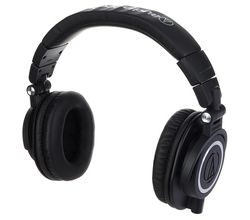
Audio-Technica ATH-M50X
- Closed, over-ear
- 45 mm drivers
- Swivelling ear cups
1.145 kr checked 25.9.2026
See price at ThomannSilent practice in a flat: the beyerdynamic DT 770 PRO in the 80 ohm version. Closed, lets almost no sound out and works straight from your piano's headphone output. The cable is 3 metres long and comes out of one side only, so you can sit freely at the piano. The cable cannot be replaced – this pair is built to stay at the piano, not to travel in a bag.
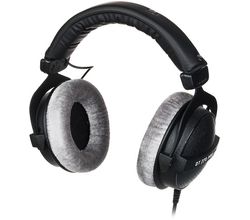
beyerdynamic DT-770 Pro 80 Ohm
- Closed-back: no sound leaks out
- Over-ear (circumaural), 80 ohm
- Works straight from a piano output
1.133 kr checked 25.9.2026
See price at ThomannThe most natural sound: the Sennheiser HD 490 PRO. Open, airy and the lightest of the three. The velour ear pads can be washed at 30 degrees, and two different pairs of pads come in the box. It is the most expensive of the three and lets sound out – but it is the one for you if you want to listen critically to your own recordings.
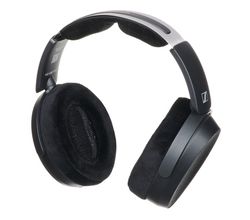
Sennheiser HD-490 PRO
- Open-back: airy, natural sound
- Over-ear, 130 ohm
- Frequency range 5 – 36,100 Hz
2.590 kr checked 25.9.2026
See price at ThomannIf you have room for two, a closed pair for practising and an open pair for listening is a very good combination. See more gear for practising and recording on the record your piano page.
Before you buy: three things
- The socket. Have a look at your piano: does it have a small or a large headphone socket? All three come with an adapter, but it is nice to know before the parcel arrives.
- Time. Headphones need to be comfortable for a whole practice session. Put them on at home, play for half an hour, and notice: do they press on your ears, or on the top of your head? Do you get warm? The body tells you more clearly than any spec sheet.
- Volume. With headphones it is easy to turn up without noticing. Start low, and take small breaks. The ears get tired before the fingers do, and tired ears do not hear the fine differences.
Listening at – or listening to
When you sit alone with the piano in your headphones, there is no room to help you. Presence in the Now (The Intuitive Pianist, Volume IV) separates listening at from listening to. Listening at is passive: the sound arrives, and you notice if something goes wrong. Listening to is an action: there is something particular you are looking for. The test is simple – after a play-through, can you answer one concrete question about what just happened? Listen for one thing at a time.
Try this tomorrow
Choose one question before you play – for example, whether the melody stands out clearly above the accompaniment. Play a short passage on headphones, and answer the question afterwards. Then turn the volume down a little and play it again. Notice how much more you hear when there is less sound.
Questions
Should I choose closed or open headphones for the piano?
Closed headphones let almost no sound out and are the kinder choice when you share your home or record. Open headphones give an airier, more natural sound, but others in the room can hear what you play.
Can I use Bluetooth headphones with a digital piano?
Standard Bluetooth adds a small delay between key and note, which you feel in fast passages. Many digital pianos do not have a Bluetooth headphone output either. At the piano, a cable is still the safe choice.
Will the plug fit my piano?
The ATH-M50x, DT 770 PRO and HD 490 PRO all come with an adapter, so they fit both the small and the large headphone socket.
More guides: Record your piano · Silent pianos · Record your piano at home · All videos